medienhaus/ group
The medienhaus/ team emerged from the "Notfalldigitalisierung" (emergency digitalisation) initiative at UdK Berlin, growing into an independent infrastructure and development team not tied to any single institute. The goal was never to build yet another isolated solution specific to Berlin University of the Arts, but to generalise the developments so other institutions could pick them up too. This follows the principle of "public money, public code." It means that even after third-party funded projects end, the resultingork can be carried forward by others, rather than having the same problems solved from scratch again and again at different institutions.
Everything developed by the medienhaus/ team sits within the space of federated technologies built on the Matrix protocol. The aim is to make sure institutions building on these free and open source software solutions don't lose out on network effects compared to platform economies. Public institutions should feel encouraged to build their own resilient digital infrastructure again, instead of drifting unnecessarily into dependency on platform economies. They can build on existing developments, adapt them to their own needs, and still stay interoperable with other institutions.
Out of these ideas came medienhaus/spaces, a communication environment that bundles various existing free and open source tools and holds them together through federated data management. At UdK Berlin, this can be found as its local instance, udk/spaces. Using medienhaus/docker, other institutions can set up and administer their own local version relatively quickly and easily.
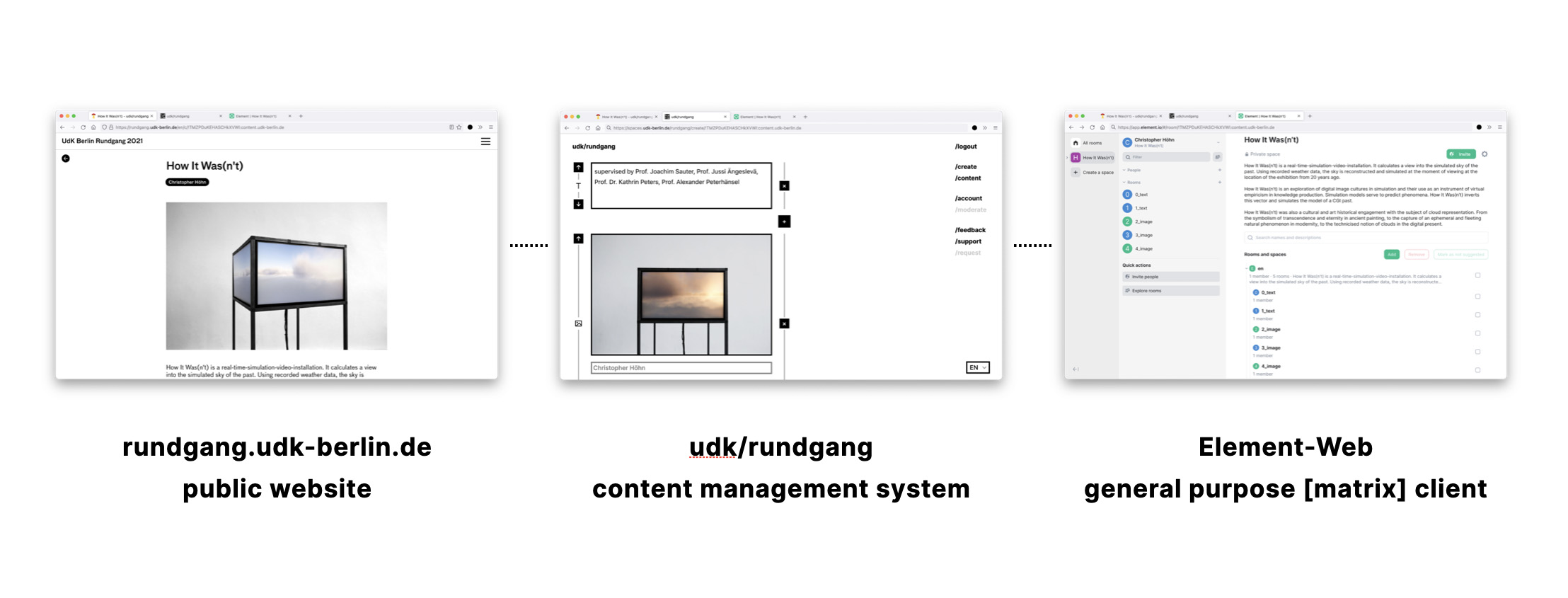
medienhaus/cms and medienhaus/api together form a publishing platform for students, originally built for UdK Berlin's digitally expanded Rundgang (open studios event). Its data management is also built on the principle of federation, making it federation-ready, meaning it could potentially allow art and design schools to create shared Rundgang or degree show websites across institutions, without needing a central platform or comparable extra effort.
medienhaus/ spaces
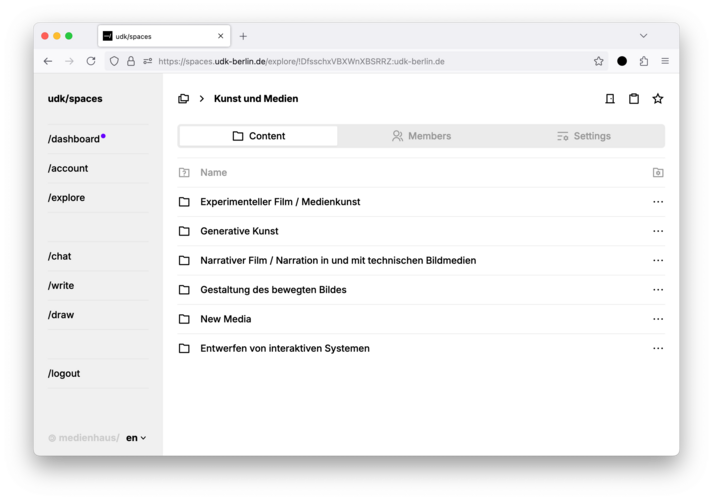
medienhaus/spaces is a communication and collaboration system for organisations that want to work together without depending on scattered, closed platforms. It combines (room-based) and direct communication with a digital representation of the organisation’s own structure, departments, teams, and members, so everything stays organised the way the organisation actually works.
Chat rooms, shared text documents, and whiteboards can all be effortlessly linked to multiple spaces within that structure, making them easy to find for the people who need them. Each space has moderators who manage access, setting items permissions and granting permissions as needed, like for example read and write permissions. Sharing works the same way: documents or entire workspaces can be shared within or across organisations, with granular access rights and referencing that lets a resource live in multiple places without duplication.
Instead of locking data into closed services like Google Drive, Dropbox, or Slack, medienhaus/spaces sits between applications, keeping data visible, controllable, and encryptable end-to-end. Existing tools can be integrated rather than replaced. Since data and interface are handled separately but connected dynamically, publishing content stays current with no extra effort.
medienhaus/spaces was developed by the medienhaus/ team, built on the Matrix protocol for decentralised, federated communication, and configurable via Docker composition for any organisation’s needs.
Demo (with limited functionality)
medienhaus/ cms
medienhaus/cms is a publishing platform built for students, developed alongside medienhaus/api and originally created for UdK Berlin's digitally expanded Rundgang (open studios event). It gives students a way to publish and present their work online without needing to build or maintain a website themselves.
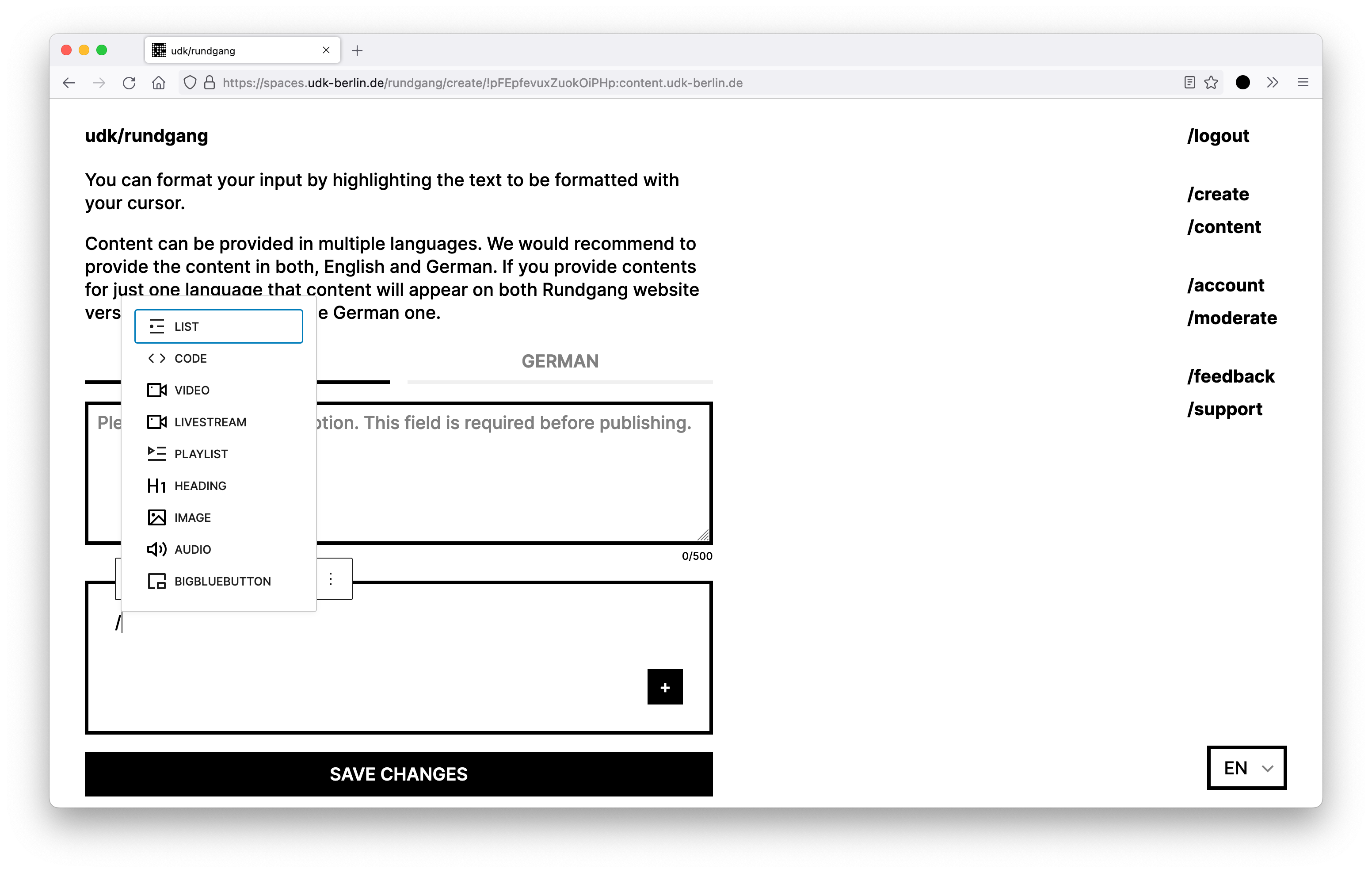
Its data management follows the same federated principle as the rest of the medienhaus/ ecosystem, making it federation-ready. Content isn't tied to a single central platform, so the underlying data can, in principle, be linked and shared across institutions. Since data and interface are handled separately, published work can be displayed in different ways over time without needing to touch the original content.
Because of this design, medienhaus/cms opens up the possibility of shared Rundgang or degree show websites across multiple art and design schools, without requiring a central platform or significant extra effort to set up.